


IMPORTANT SAFETY INFORMATION
Severe diarrhea associated with dehydration and infection occurred in patients treated with Verzenio. Across five clinical trials in 3899 patients, diarrhea occurred in 81 to 90% of patients who received Verzenio. Grade 3 diarrhea occurred in 8 to 20% of patients receiving Verzenio. Most patients experienced diarrhea during the first month of Verzenio treatment. Across trials, 19 to 26% of patients with diarrhea required a Verzenio dose interruption and 13 to 23% required a dose reduction. In EMBER-3, diarrhea occurred in 86% of patients who received Inluriyo in combination with Verzenio; Grade 3 or 4 diarrhea occurred in 9%.
Instruct patients to start antidiarrheal therapy, such as loperamide, at the first sign of loose stools, increase oral fluids, and notify their healthcare provider for further instructions and appropriate follow-up. Follow specific dose modification and management instructions located in the Prescribing Information for each drug.
Neutropenia, including febrile neutropenia and fatal neutropenic sepsis, occurred in patients treated with Verzenio. Across five clinical trials in 3899 patients, neutropenia occurred in 37 to 51% of patients receiving Verzenio. A Grade ≥3 decrease in neutrophil count (based on laboratory findings) occurred in 19 to 32% of patients receiving Verzenio. Febrile neutropenia has been reported in <1% of patients exposed to Verzenio across trials. Two deaths due to neutropenic sepsis were observed in MONARCH 2. Inform patients to promptly report any episodes of fever to their healthcare provider. In EMBER-3, neutrophil count decreased in 86% of patients who received Inluriyo in combination with Verzenio; Grade 3 or 4 decreases occurred in 21%.
Monitor complete blood counts prior to the start of Verzenio therapy, every 2 weeks for the first 2 months, monthly for the next 2 months, and as clinically indicated. Follow specific dose modification and management instructions located in the Prescribing Information.
Severe, life-threatening, or fatal interstitial lung disease (ILD) or pneumonitis can occur in patients treated with Verzenio and other CDK4/6 inhibitors. In Verzenio-treated patients in EBC (monarchE), 3% of patients experienced ILD or pneumonitis of any grade: 0.4% were Grade 3 or 4 and there was one fatality (0.1%). In Verzenio-treated patients in MBC (MONARCH 1, MONARCH 2, MONARCH 3, EMBER-3), 3.2% of Verzenio-treated patients had ILD or pneumonitis of any grade: 0.5% had Grade 3 or 4, and 0.5% had fatal outcomes. In EMBER-3, ILD or pneumonitis occurred in 2.9% of patients who received Inluriyo in combination with Verzenio.
Monitor patients for pulmonary symptoms indicative of ILD or pneumonitis. Symptoms may include hypoxia, cough, dyspnea, or interstitial infiltrates on radiologic exams. Infectious, neoplastic, and other causes for such symptoms should be excluded by means of appropriate investigations. Follow specific dose modification and management instructions located in the Prescribing Information.
Grade ≥3 increases in alanine aminotransferase (ALT) (2 to 6%) and aspartate aminotransferase (AST) (2 to 3%) were reported in patients receiving Verzenio across four clinical trials in 3767 patients (monarchE, MONARCH 2, MONARCH 3, EMBER-3).
Monitor liver function tests (LFTs) prior to the start of Verzenio therapy, every 2 weeks for the first 2 months, monthly for the next 2 months, and as clinically indicated with Verzenio. Monitor ALT and AST during treatment with Inluriyo as clinically indicated. Follow specific dose modification and management instructions located in the Prescribing Information for each drug.
Deaths due to venous thromboembolism (VTE) have been reported in patients treated with Verzenio. VTE were reported in 2 to 5% of patients across four clinical trials in 3767 patients treated with Verzenio (monarchE, MONARCH 2, MONARCH 3, EMBER-3). Verzenio has not been studied in patients with early breast cancer who had a history of VTE. Monitor patients for signs and symptoms of venous thrombosis and pulmonary embolism and treat as medically appropriate. Follow specific dose modification and management instructions located in the Prescribing Information.
Embryo-Fetal Toxicity: Verzenio and Inluriyo can cause fetal harm when administered to a pregnant woman. Advise pregnant women and females of reproductive potential of the potential risk to a fetus. Verify pregnancy status in females of reproductive potential prior to initiating treatment. Advise females of reproductive potential to use effective contraception during treatment and for at least 3 weeks after the last Verzenio dose or 1 week after the last Inluriyo dose, whichever is longer. Advise males with female partners of reproductive potential to use effective contraception during treatment with Inluriyo and for 1 week after the last Inluriyo dose. Verzenio may impair fertility in males of reproductive potential. Inluriyo may impair fertility in females and males of reproductive potential.
Increased Serum Creatinine Without Affecting Renal Function: Verzenio can increase serum creatinine. Across five clinical trials in 3899 patients (monarchE, MONARCH 1, MONARCH 2, MONARCH 3, and EMBER-3), Verzenio can increase serum creatinine. These increases were not associated with changes in glomerular function. During Verzenio treatment, use alternative measures that are not based on serum creatinine to assess renal function, such as BUN, cystatin C, or calculated GFR.
Lactation: Because of the potential for serious adverse reactions in the breastfed child, advise lactating women to not breastfeed during treatment with Verzenio or Verzenio in combination with Inluriyo and for 3 weeks after the last dose of Verzenio or 1 week after the last dose of Inluriyo, whichever is longer.
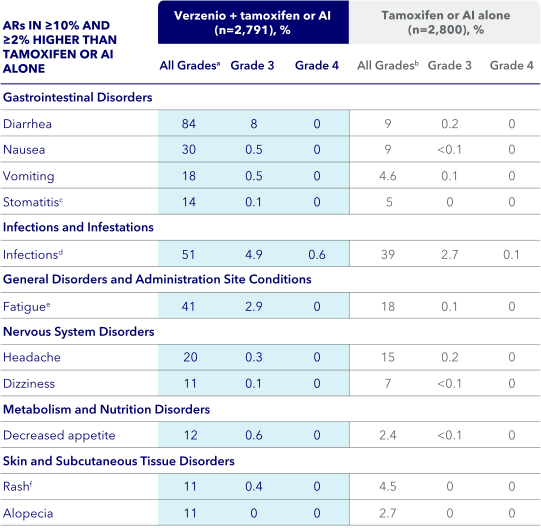
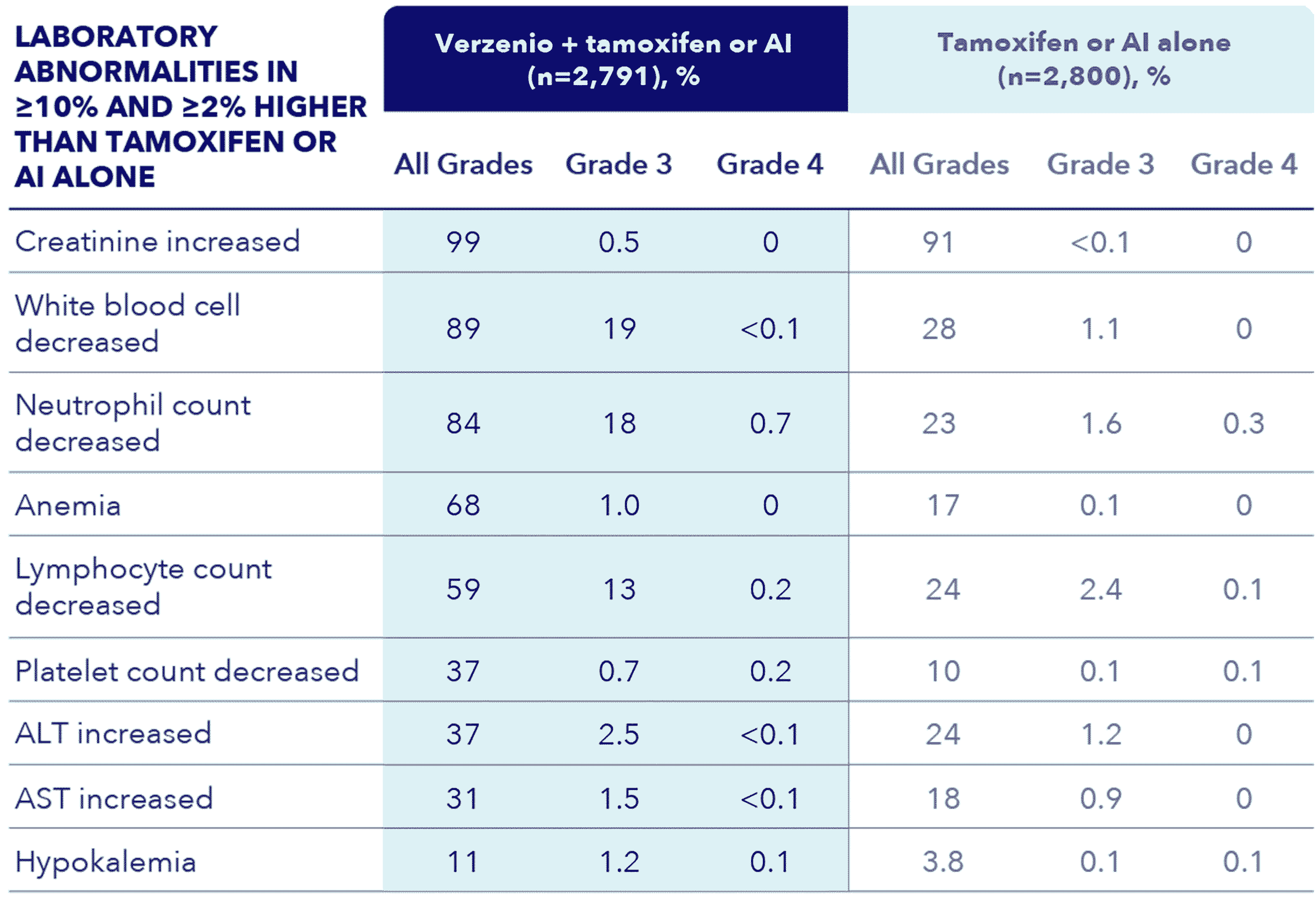
The most common (all grades, ≥10%) adverse reactions including laboratory abnormalities observed in monarchE for Verzenio plus tamoxifen or an aromatase inhibitor were increased creatinine, decreased neutrophils, diarrhea, decreased hemoglobin, decreased lymphocytes, infections, fatigue, increased ALT, decreased platelets, increased AST, nausea, headache, vomiting, stomatitis, decreased appetite, decreased potassium, rash, dizziness, and alopecia.
The most common (all grades, ≥10%) adverse reactions including laboratory abnormalities observed in MONARCH 3 for Verzenio plus anastrozole or letrozole were increased creatinine, decreased hemoglobin, diarrhea, decreased neutrophils, decreased lymphocytes, increased ALT, fatigue, infections, nausea, increased AST, decreased platelets, abdominal pain, vomiting, alopecia, decreased appetite, constipation, rash, pruritus, cough, dyspnea, dizziness, decreased weight, and influenza-like illness.
The most common (all grades, ≥10%) adverse reactions including laboratory abnormalities observed in MONARCH 2 for Verzenio plus fulvestrant were increased creatinine, decreased neutrophils, diarrhea, decreased hemoglobin, decreased lymphocytes, decreased platelets, fatigue, nausea, infections, increased ALT, increased AST, abdominal pain, decreased appetite, vomiting, headache, dysgeusia, alopecia, stomatitis, pruritus, cough, dizziness, edema peripheral, rash, pyrexia, and decreased weight.
The most common (all grades, ≥10%) adverse reactions including laboratory abnormalities observed in MONARCH 1 for patients treated with Verzenio were increased creatinine, diarrhea, decreased neutrophils, decreased hemoglobin, fatigue, nausea, decreased appetite, decreased lymphocytes, decreased platelets, abdominal pain, vomiting, infections, increased ALT, increased AST, headache, cough, constipation, arthralgia, dry mouth, stomatitis, decreased weight, dysgeusia, alopecia, pyrexia, dizziness, and dehydration.
The most common (all grades, ≥10%) adverse reactions including laboratory abnormalities observed in EMBER-3 for Verzenio plus Inluriyo were decreased neutrophils, diarrhea, decreased hemoglobin, decreased lymphocytes, nausea, decreased platelets, fatigue, increased triglycerides, infections, increased AST, increased creatinine, increased ALT, vomiting, musculoskeletal pain, abdominal pain, decreased appetite, increased cholesterol, rash, cough, headache, and decreased weight.
Strong and moderate CYP3A inhibitors increased the exposure of abemaciclib plus its active metabolites to a clinically meaningful extent and may lead to increased toxicity. Avoid concomitant use of ketoconazole. Ketoconazole is predicted to increase the AUC of abemaciclib by up to 16-fold. In patients with recommended starting doses of 200 mg twice daily or 150 mg twice daily, reduce the Verzenio dose to 100 mg twice daily with concomitant use of strong CYP3A inhibitors other than ketoconazole. In patients who have had a dose reduction to 100 mg twice daily due to adverse reactions, further reduce the Verzenio dose to 50 mg twice daily with concomitant use of strong CYP3A inhibitors. If a patient taking Verzenio discontinues a strong CYP3A inhibitor, increase the Verzenio dose (after 3 to 5 half-lives of the inhibitor) to the dose that was used before starting the inhibitor. With concomitant use of moderate CYP3A inhibitors, monitor for adverse reactions and consider reducing the Verzenio dose in 50 mg decrements. Patients should avoid grapefruit products.
Avoid concomitant use of strong or moderate CYP3A inducers with Verzenio and consider alternative agents. Coadministration of strong or moderate CYP3A inducers decreased the plasma concentrations of abemaciclib plus its active metabolites and may lead to reduced activity.
With Inluriyo, avoid concomitant use with strong CYP3A inhibitors. If concomitant use cannot be avoided, decrease the Inluriyo dosage. Avoid concomitant use with strong CYP3A inducers. If concomitant use cannot be avoided, increase the Inluriyo dosage. See Prescribing Information for recommended dosage modifications. Imlunestrant inhibits both P-gp and BCRP. Avoid concomitant use unless otherwise recommended in the Prescribing Information for P-gp or BCRP substrates where minimal concentration changes may lead to serious adverse reactions.
With severe hepatic impairment (Child-Pugh C), reduce the Verzenio dosing frequency to once daily. The pharmacokinetics of Verzenio in patients with severe renal impairment (CLcr <30 mL/min), end-stage renal disease, or patients on dialysis is unknown. No dosage adjustments are necessary in patients with mild or moderate hepatic (Child-Pugh A or B) and/or renal impairment (CLcr ≥30-89 mL/min). With Inluriyo, reduce the dose in patients with moderate or severe hepatic impairment; the recommended dosage for patients with moderate (Child-Pugh B) or severe (Child-Pugh C) hepatic impairment is 200 mg once daily. No dosage modification is recommended for patients with mild hepatic impairment (Child-Pugh A).
Verzenio (abemaciclib) is available as 50 mg, 100 mg, 150 mg, and 200 mg tablets.
Inluriyo (imlunestrant) is available as 200 mg tablets.
Please click to access Prescribing Information for Verzenio.
Please click to access Prescribing Information for Inluriyo.
VZ IN HCP ISI ALL APPR